Discover The Stories StoryTerrace Help Share.
Explore inspiring stories, expert tips, and the latest trends in personal biography creation on our blog.

How to Write a Book About Your Life: A Guide That Works
Seven honest steps from a team that's helped thousands of people write their life stories. What works, where people stall, and when to get help.
What Is a Ghostwriter? Meaning, Definition & How It Works
A ghostwriter writes books and memoirs credited to someone else — including most celebrity autobiographies. The full meaning, and how it really works.
How Much Does a Ghostwriter Cost in 2026? Real Prices
How much does a ghostwriter cost? From £999/$1,200 for a short book to £60K+ for a premium memoir — real 2026 prices, not vague ranges.
How Long Does It Take to Write a Book? Real Timelines
How long does it take to write a book? Real timelines: 6–12 months solo, 6–9 months idea-to-print with a ghostwriter. Stage-by-stage breakdown inside.
Memoir vs Autobiography: 5 Key Differences (With Examples)
Memoir vs autobiography explained in plain English: 5 key differences, a comparison table and famous examples so you know which one to write.
.webp)
Browse all articles

Editing and Proofreading Your Book
After you've written your memoir, you'll need to start editing and proofreading. Find out how to do both here.
Congratulations! You’ve written your book. All that’s left to do is make sure it all makes sense - and you’re ready to print. But where do you start? To many people, editing and proofreading are the same thing. This is a common misconception:
Editing comes first, after you’ve written your first draft. Editing is all about the actual content of the writing, and involves making sure your ideas are expressed logically, in a clear and coherent narrative. This article will tell you exactly how to edit your book.
Proofreading comes after the editing process, and is less about content, more about language. It involves checking over spelling, punctuation and grammatical errors, as well as format.
Before you edit:
We’re sure you’ll be thrilled to hear that the first step after you’ve written your story is, actually, to do nothing at all. Take a break! It’s a good idea to have some space from your writing so that when you do revisit, you’re able to read the story with fresh eyes.
Once you’re ready, before you change a word, read through the whole story. You will have been staring at your work, likely on a computer, or weeks or months. We recommend that you change the format for this first read-through. Try changing the typeface and font size to make the words less recognisable. If you can, print the whole thing out - so you can get out of the screen, and jot down some notes without actually changing anything. This also makes the manuscript easier to read. Of course, printing out an entire biography may not be possible, and some people do prefer to read on-screen, so do whatever suits you.
Whilst editing:
In terms of the editing process, the best way to approach your project is one step at a time. Ask yourself the following questions, and don’t be alarmed if it feels like you’ve got a lot of work ahead of you - editing can involve major changes or even a complete rewrite:
Does the opening paragraph clearly indicate the purpose of the text?
Is there a clear purpose throughout the text?
Is every sentence relevant to the purpose of the text?
Does each paragraph contain one idea?
Does the text flow logically?
Have you used a varied sentence structure and vocabulary?
Have you used an appropriate tone for your reader?
Does the last paragraph satisfyingly conclude the story?
After editing:
Take a break. Let someone else do the work for you! After you’ve edited your story, find a friend or family member that you trust to read through your book. Showing someone else your work and getting feedback is an important stage of the process, because it gives you an insight into what your audience might think of your book when it’s finished. Up until now, you’ve been the only person that’s read your story, and a fresh pair of eyes could point out a fundamental error that you might have missed, or amend part of a story you remembered incorrectly.
If you aren’t sure who to ask, or you don’t feel that anyone you know is suitable, why not ask a professional?

Before you proofread:
Have you finished editing? There’s no point in proofreading if you’re going to make further changes to the text or the structure of your book. It’s a good idea to design your book first, including photographs, layout and format, which you can find out more about in Chapter 7.
Next, establish what you’re looking for when you’re proofreading. What are your common mistakes? Make a list to stay focused when reading: spelling, punctuation and grammatical errors, as well as consistent use of language, style and formatting.
It is also advisable to take another break before you start proofreading, to distance you from the writing. Take a day, at least, to recuperate.
Whilst proofreading:
Reading out loud helps you spot errors and run-on sentences that reading silently risks missing. If you’d prefer, read from a printout, and use a blank sheet of paper to cover the lines below the one you’re reading to decrease your chances of missing mistakes. On-screen, use search functions to pick out common mistakes. For example, if you frequently confuse “it’s” and “its”, search ‘it’ to check for errors.
You’ve read your story for the final time, you’ve made all the relevant changes, and everything looks perfect! What else could you possibly have left to do?
Read Chapter 6: How To Digitise Your Photos

Designing and Printing Your Book
The design process is a crucial element of writing a memoir. If you choose the wrong layout and format or printing process, it could ruin your whole book.
This is the seventh part of our 'Ultimate Guide to Writing a Memoir.'To access the rest of the guide, click here.
In this chapter, you’ll learn everything you need to know about the design process. This includes:
- Layout and format
- Choosing a designer
- Printing your book
Layout and Format
You can design and format your own book - but we wouldn’t recommend it. This is because there are so many little things to think about, and so many big things you could forget. Leave it to the professionals!
If you would like to have a go yourself, here’s what you need to think about:
- What typeface do you want to use? Serif or sans serif?
- What size book do you want to end up with? A5? A4? Square?
- How many photos do you want to include?
- What’s going on the back cover - or the front cover? (We’ll get to that.)
And that’s just the tip of the iceberg.
Choosing a Designer
In terms of choosing a designer, make sure you check out their previous work and customer reviews to see if they’re really someone you want to work with. Are they experienced at typesetting and laying out a book? Have they got templates to work with? If not, it might be wise to steer clear.
At Story Terrace, in addition to our own templates, we can also create bespoke designs and custom covers to suit your project. We use the same trusted designers for every project - so we know what works, and what doesn’t - and you don’t have to worry about a thing.
Take a look at our sample books for inspiration.
Printing Your Book
It’s the final step. You’ve done all the hard work and now it’s time to reap the rewards by holding that physical copy of your book in your hands for the very first time. But what’s that? Your cover hasn’t aligned properly, and half the title has been cut off.
You may be close to the end, but you certainly don’t want to lose focus. Whilst the printing is largely out of your hands, you can make sure that you’ve done your research.
The cost of printing will depend on how many copies you order. Usually, the more copies you order, the cheaper the cost per book will be. Additionally, other contributing factors you might want to consider are whether you want a hardcover or softcover, full color or black and white book. Printers’ costs vary, so it’s worth getting a few quotes. Some printers won’t do short print runs (e.g., of 4 copies, like our printer does), so that’s also something you might want to think about. Equally, if you’re getting your books printed abroad, you’ll need to factor in the cost of shipping too.
Read Chapter 8: How To Make Your Book Cover Stand Out

Structure your Life Story
5 great ways to structure your life story or memoir.
Ultimate Guide to Writing a Memoir (Part 2)
Introduction
This is the second part of our 'Ultimate Guide to Writing a Memoir.'
To access the rest of the guide, click here.
Organizing Your Memories
So you've gathered everything you need to write your memoir. If you need more help, make sure you've read Chapter 1: Organising Your Memories, where you can download our Memory Prompt Cheat Sheet to uncover forgotten memories. But what comes next?
There are many ways to structure your memoir. There is no right or wrong way to do it, but it’s one of the biggest choices you will make about your book. Structure is crucial to the readability of your book. You might write beautifully, but without any kind of structure, your words will be scattered and disorganized.
So how do you structure your life story? We’ve outlined five of the best approaches to help you choose.
1. The Chronological Approach
One of the simplest ways to structure your life story and develop a narrative is chronologically—in the order that it happened. In this case, you’ll start at the beginning of your timeline and work your way through from birth to the present day. Writing chronologically facilitates fluid and realistic character development, and as a result, allows events to mirror the way your book will be read.

A surprising example of a chronological structure: Time’s Arrow by Martin Amis
Shortlisted for the Booker Prize in 1991, Martin Amis’ book is written in reverse chronological order. It follows the story of a doctor getting younger and younger as time passes in reverse. This disorienting narrative makes for an unsettling and irrational read and emphasizes the importance of deliberate structure within a book.
2. The Basic Three Act Structure
The Basic Three Act structure splits the narrative into three parts: the setup, confrontation, and resolution. It is one of the easiest ways to structure your life story.
- Setup: Introduces the characters, their relationships, and the environment they live in. It also presents a strong hook—an exciting incident that provokes a change in the protagonist's routine.
- Confrontation: Makes up the main bulk of your story. The stakes are raised throughout the act until a major twist, usually a moment of crisis, initiates the start of act three—the resolution.
- Resolution: Presents the final showdown and draws together and explains all the different strands of the plot.
A great example of the Basic Three Act structure: The Titanic by James Cameron
The setup introduces Rose, an unhappy woman engaged to a man she detests. Jack rescues her following her attempt to commit suicide. The confrontation sees the stakes raised when Rose’s fiancé begins to suspect their affair. In a moment of crisis, the famously unsinkable ship hits an iceberg. The resolution follows Rose and Jack as they try to escape the sinking Titanic, ultimately ending in Jack’s death and Rose’s survival. Rose recounts the series of events as an old woman as the story ends.
3. Freytag’s Pyramid
Freytag’s Pyramid is a more complex version of the Basic Three Act structure, with five parts rather than three. These are: exposition, rising action, climax, falling action, and resolution.
- Exposition: Introduces the characters and backdrop of the story.
- Rising Action: Follows the series of events that occur straight after the exposition and leads up to the climax.
- Climax: The turning point that changes the protagonist’s fate.
- Falling Action: The consequence of the climax, where the conflict between protagonist and antagonist unravels in a final moment of suspense.
- Resolution: Creates a sense of catharsis in conclusion to the story.
A great example of Freytag’s Pyramid: Little Red Riding Hood by Charles Perrault
The exposition introduces Little Red Riding Hood as she takes a basket of food to her grandmother’s house. Before she gets there, the wolf eats and takes on the identity of her grandmother. This is the rising action. The wolf convinces Little Red that he is her grandmother and eats her in the climax. In the falling action, the wolf falls asleep. The huntsman finds the wolf and cuts open his stomach. The resolution sees Little Red and her grandmother freed, and the wolf killed.
4. In Media Res
Latin for 'into the middle of things', it’s unsurprising that this structure starts your book right in the middle of the story. This is usually in the midst of a crisis or at a crucial point of action. This structure gives the reader a sense of what’s to come before reverting to the beginning of the story to find out how they got there. It’s also a great way to hook the reader from the first page.
A great example of in media res: The Odyssey by Homer
The famous poem opens in media res, with most of Odysseus’ journey already finished. Flashbacks and storytelling describe the events and characters met along the way.
5. The Hero’s Journey
One of the most popular methods used to structure your life story is the Hero's Journey. It was first conceptualized by Joseph Campbell in his book, The Hero With A Thousand Faces, and has since been adapted by Hollywood executive, Christopher Vogler. There are 12 stages to the Hero's Journey.
- Ordinary World: Introduces the hero.
- Call to Adventure: A challenge or problem.
- Refusal of the Call: The hero is reluctant to accept the adventure.
- Meeting a Mentor: Gives the hero confidence.
- Crossing the Threshold: The hero commits to the adventure.
- Tests, Allies, and Enemies: The hero faces challenges.
- Approach to the Innermost Cave: The hero draws closer to the goal.
- Ordeal: The hero faces a major crisis.
- Reward: The hero achieves the goal.
- The Road Back: The hero begins the journey home.
- Resurrection: The hero faces a final test.
- Return with the Elixir: The hero returns home changed and with new knowledge.
A great example of the Hero’s Journey structure: Star Wars directed by George Lucas
In the ordinary world, Luke Skywalker lives on a moisture farm on Tatooine. R2-D2 gives Luke a message from Princess Leia, asking Obi-Wan Kenobi to help her as the call to adventure. Obi-Wan gives Luke his father's lightsaber, but at first, Luke is reluctant to accept his offer in the refusal to call. In addition, Obi-Wan, the mentor, offers to train Luke to become a Jedi. Crossing the first threshold, Luke finally agrees to go with Obi-Wan to Alderaan to deliver the plans for the Death Star to Leia's father.
Han Solo and Chewbacca, their allies, agree to take Luke and Obi-Wan to Alderaan. In the approach to the innermost cave, the Death Star destroys Alderaan. They invade the Death Star and rescue Princess Leia, but Darth Vader kills Obi-Wan Kenobi in the ordeal. The reward sees Luke join the Rebels to destroy the Death Star, who also refuses Han Solo's offer to leave. Luke chooses to help overcome the Galactic Empire in the road back.
Luke remembers Obi-Wan's advice and destroys the Death Star using the Force in the resurrection, and wins a medal, finally taking his first steps towards becoming a Jedi in the return with the elixir.
At the end of the day, your story can be as structurally unpredictable as life itself. It’s your life and your story. We hope these methods have opened your minds to the vast possibilities and different forms your life story can take. But remember, there’s no right or wrong way to structure your life story: it’s up to you.
Read Chapter 3: Writing (the nitty gritty!)

Get to Know Your Parents - Before They Were Your Parents!
Three great ways to capture your parents' life stories for future generations of your family
How much do you really know?
So many of your parents' stories took place before you were born, or were old enough to understand. Your parents know your whole history – but chances are you only know a fraction of theirs.
As our parents get older, these stories start to become more important to us. We want to preserve their memories – we don’t want them to be lost.
However you choose to record your parents’ life stories, the first step is to start talking. So today, we’re sharing four great ways to get the ball rolling.
1. Picture this…
A lot of our customers find old photo albums a great place to start. Take a day to bring out the old family albums with mum or dad. You'll find that it jogs the memory, brings up stories you never even knew about, and it’s also a fantastic way to begin assembling material for a memoir or biography.
It’s also an opportunity to digitize old pictures, which we strongly recommend. Nowadays, we are overwhelmed with photos. But older photos, from our parents’ childhood years, are often few and far between. It’s very likely you have no ‘back up’ of these pictures – old film and prints are liable to get damaged and lost forever! For this very reason, these older photos are infinitely more precious.
Luckily, with advances in technology, it has become easier to preserve old photos. Pictures can be scanned and stored safely online so that precious memories are not lost. As an added bonus, they are then easy to reproduce in a memoir or photo book. You can do it yourself by downloading an app, using a nearby print shop, or purchasing your own scanner.
2. Be your own family’s archaeologist
If you’re really serious (and brave), it’s time to have a look around the attic. Familiar with the film, Titanic? A search for a precious necklace, missing in the depths of the Atlantic Ocean led to the discovery of something priceless: the timeless love story of Jack and Rose. It’s not just Hollywood fiction – objects can really tell stories!
There’s a reason historians spend time digging up old Roman pots – it says a lot about how people lived their lives. Material culture can be just as important for you as your family’s historian. Your mom or dad’s memory won’t be infallible – mementos from the past can be important in bringing those truly old tales back to the present.
‘Why do you always wear that necklace, Mom?’ ‘Well, I was 13 and I was walking to school one day….’
By examining your parents’ old possessions, you won't just jog their memory, but make the story come alive for yourself, too!
3. Take note!
Now you’ve got your parents talking, you’ll want to keep a pen and paper handy. The stories your parents and grandparents share can be important insights into the past.
Stories dating to a time before you were born:
‘I had to be evacuated during WW2, I can still remember the sounds of the air raid sirens.’
Realities that seem so contrary from modern life:
‘I got my first job at 11 and have worked ever since.’
Make sure to jot down these little bits of information. And don’t forget to ask questions - use our memory prompts if you need some inspiration! It's through your curiosity that their life stories can truly take form.
4. Get professional help from Story Terrace!
We would all love to personally record our parents’ life stories. But it often isn’t that easy. It can be difficult to find the time to finish a project. It’s also hard to be an expert interviewer and writer on the first attempt. And then you'll still need to transform all of that work into a readable format you can share with your family – which involves editing the text, and designing and printing everything yourself.
Story Terrace is here to help you capture your parents’ lives in a book. Our professional ghostwriters have extensive experience interviewing our customers’ parents and structuring their memoirs and biographies. We have in-house editors who manage the process end-to-end, and we know how to beautifully present precious memories in a way that will last.
If you’d like to inquire about our services, feel free to contact us.

How StoryTerrace matches you with your perfect ghostwriter!
Our 4 steps to match you with the perfect ghostwriter for your story.
Capture the memories of your loved ones
That book then can be an amazing resource
Congratulations! You’ve decided to create your very own, beautifully bound StoryTerrace book. Our professional ghostwriters will help you to make your life story the best it can be.
The next step is to find your writer. With the largest pool of specialist ghostwriters in the world, part of what makes StoryTerrace unique is our ability to pair you with the perfect biographer for you.
As our Managing Editor, Alice Nightingale, says, “we pride ourselves on matching our clients with their ghostwriters carefully.” That means you can rest assured, knowing that you'll be working with a writer who can capture your story, find your voice, and make the process relaxed and enjoyable.
But how?
This happens through StoryTerrace’s tried and tested method of ghostwriter selection. So, how does it work? The infographic below explains the step-by-step process we use.
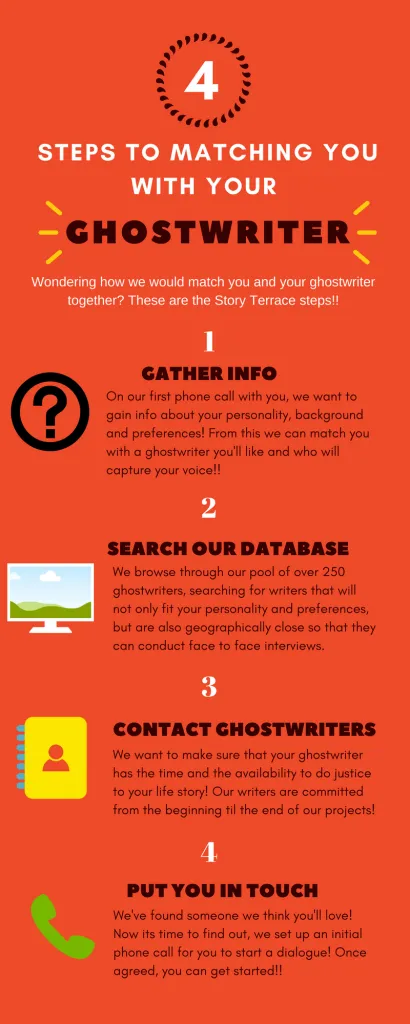
Step 1: Getting to know you
After you’ve decided to write your life story with StoryTerrace, you’ll have a brief consultation with your editor. We try to gather as much information as possible to ensure we find you the perfect fit.
“Everyone I spoke with at StoryTerrace was absolutely lovely and listened to all I had to say,” Isabella Matthews, StoryTerrace customer.
We want to know about your personality! For instance, matching you with someone who shares your sense of humour can help to build a rapport between you and your ghostwriter, making the writing process much more enjoyable.
At this stage, learning about your background is also extremely useful. It’s important that your writer understands you. When it comes to forging a mutual bond and finding your voice, a shared background or a common experience can make all the difference.
We also use this stage to ask about your preferences. We can accommodate most requests - whether it's something small - ‘I don’t want to work with someone that supports my rival football team’, or something more personal: ‘I would feel more comfortable sharing my experiences with someone of my own age’. Our goal is for customers and writers to feel comfortable, and create an atmosphere conducive to writing.
Step 2: Writer Search
StoryTerrace works with hundreds of professional journalists and authors - the largest pool of specialist ghostwriters in the world. That said - we know our writers like the back of our hands. Using the information from your consultation, your editor will propose ghostwriters who are a good fit for the project. Have a look at our writers’ profiles.
Additionally, we also consider your location. Interviews with your writer form the backbone of your story. We are almost always able to match customers with writers who are close enough to conduct the interviews in person, face-to-face. We think this makes the process more enjoyable, helping to develop a relationship between customer and ghostwriter, and making the end result more personal.


Step 3: Consult the ghostwriter
Next, we contact the top candidates for the job, and tell them about you and your project! It’s important for you to like your ghostwriter, and also for them to like you. If a mutual relationship flows, the final outcome becomes a labor of love.
It sounds obvious, but we also make sure that the writer is available for the duration of the project! You can read about the packages StoryTerrace offers here. For example, if you’ve purchased a Compact book package, your ghostwriter must be available for 3-4 hours of interviews and able to produce 5,500 words of your story. If you’ve paid for a Novella, the ghostwriter will carry out 8-10 hours of interviews and produce 20,000 words.
Whichever package you choose, the writer will be committed to the project from beginning to end, so we ensure you have the time together to tease out your life story!
“Sara really took the time to help me find the structure in the story of my life!” Teresa Samuels, StoryTerrace customer.
Step 4: Getting in contact
Hurrah, we’ve found your match! Now it’s time to put the two of you in contact.
You will have an initial phone call with your writer to make sure you’re happy with the match. This is an important opportunity to really discuss what you want the book to be about. Even at this stage, if you aren’t happy – you can choose a different writer. Writing your life story with StoryTerrace is, from beginning to end, a collaborative effort.
“Initially, we chatted on the phone and Lisa made it clear from the outset that if we didn’t ‘hit it off’ she would bow out gracefully and I could choose another writer”. David Taylor, StoryTerrace customer
So there it is, the secret to finding your perfect ghostwriter! If you’re ready to get started, contact us to begin your StoryTerrace experience today!
How to Collect and Record Memories
Some fun and creative ways to start preserving your memories for future generations and family
Turning the meaningless into the meaningful
Create an amazing resource full of memories
We record memories and keep mementos, often without realizing, on a daily basis. We know the stories behind the photos and trinkets we keep, but to a stranger, our collection is meaningless.
For example, you may pick up a photo of yourself with friends, sitting around a table. You look fondly at the picture, chuckling, remembering all the events that occurred that night. But, let’s say your great-granddaughter picks up this same photo 40 years from now. What would she see?
Now imagine this same photo, but with the caption: ‘The gang, aged 25, the night Dan proposed to Jen’. Not only will your great-granddaughter laugh at what you’re all wearing, she now has context behind the image. Having a simple record of who people are and your relationship to them can turn something meaningless into something meaningful for those around you.
Collecting Memories
So what exactly should you be collecting? Well, we’ve comprised a list of useful items that will trigger your memories when recounting your stories.
Photographs and Films
Photographs and films are probably the most obvious visual cues for recalling memories. A photograph directly shows what someone or something looked like. However, this doesn't mean the picture alone conveys the whole story, or how you experienced it.
Especially in this day and age, images can be construed to convey a certain message. Therefore, relying on photographs alone to remember people and events might not be completely reliable.
Rachel LaCour Niesen, a keen photograph preservationist, gives us an insight into why she is so passionate about photography, as well as ideas on how to display photographs:
"There’s magic in holding printed photos in your hands, in passing them around the table. That's because analog photos trigger powerful emotional responses. Most families have hundreds of analog photos in their homes. These photos hold valuable family memories; they are passports to a place called memory. We must make an effort to rescue them from deterioration and loss. When analog photos are in danger, family history is also in danger.
“Indeed, photographs are a living, breathing archive. They are meant to be displayed and shared. Whether they're displayed in frames, in an old-school slideshow, or in albums, I hope all families recognize the value of their personal photographic histories. Can you imagine never having the magical experience of discovering a box of family photos? It’s like finding buried treasure! I would love to guarantee that experiences like that aren’t lost in the future.”
For more ideas and advice on how to preserve old photographs visit Rachel’s site: SaveFamilyPhotos.com
Diaries and Letters
Diaries and letters serve as powerfully written cues for recalling memories. Letters can reveal a great many things, from sharing big news to revealing secret love affairs. Meanwhile, diaries are a personal way of recording your thoughts and feelings whilst they're still fresh, as it is often harder to remember details in hindsight.
In an interview conducted by the National Diary Archives, specialist diary collector, Sally Macnamara, gives us an insight into why this became her passion:
“The most important thing I would say is that real life is so much more exciting and rewarding to read about than any story anyone could make up. And that no matter who you are, every life, every true story, has fascinating aspects to it, and that we all have a story to tell. So many people think they have nothing to share, nothing to teach, nothing that’s worthwhile in their life, but that is so untrue.”
For more inspiration on collecting diaries and to follow some truly amazing diary stories visit Sally’s Diaries.
Newspaper Clippings
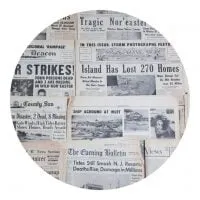
Saving newspaper and magazine clippings of significant stories is another great way to preserve memories. Many of us rely on cues to jog our memories. Therefore, keeping a record of important news stories is a great way to remind us what we were doing at the time of the event or at the point of reading the story.
Additionally, keep meaningful magazine clippings and display them in a frame or in a book. Preserving clippings in this way can also be a great way of presenting an album of events that occurred throughout your life, quickly and with little effort.
Mementos
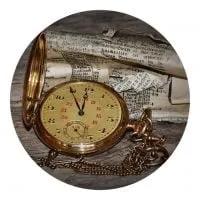
The beauty of collecting mementos is that every collection, and every item in that collection, is unique. Keeping a box of objects you’ve collected over the years serves as a treasure trove for your grandchildren. You'll probably feel nostalgic, too.
The objects do not need to be valuable or even attractive. It’s all about keeping items that will remind you of a special time. Keeping a ticket stub may be all you need to remember one of the best weekends of your life.
The box itself could also be something significant. Just as all the objects inside are specific and special to you, so the container could be too. Some people may keep their trinkets in their favorite cookie box. Others may appropriate an old shoe box and collage it with stamps they’ve collected.
So, what are you waiting for?
There is no specific time to start recording your memories. However, the sooner you start, the more memories you'll preserve and the more you'll have to share with future generations. It’ll also make the process of writing your own life story or having a ghostwriter to do the writing for you much simpler when you come to it.

Memories: the Importance of Sharing Them
Why it's so important that we share our memories with our families and loved ones!
Memories are the adhesive that fastens pictures to the walls of the rooms of our past. Over time the tenacity of the glue may start to wear, the frames may tilt and you see the images from a different angle; or they might drop off the wall completely.
Memory is the lens through which we gaze into the future. Our past experiences, emotions, observations; our sense of identity ultimately shapes our future thoughts and actions. And they are constructed through the tinted viewfinder of our mental memoirs.
“Life can only be understood backwards, but it must be lived forwards.” - Søren Kierkegaard
Documenting Change
Have you ever come across an old storage box and spent hours going through your old possessions; letters, birthday cards, photographs? Reminiscing can be one of life's true, unpredictable, and thrilling delights. With it can come realization of how far you have come, how much you have changed; or haven’t. The overwhelming oneness of you and your past, the present, and your hopes for the future.
In his play The Cocktail Party, T.S. Eliot writes:
"We die to each other daily. What we know of other people is only our memory of the moments during which we knew them. And they have changed since then."
Our memories of other people are based on the brief encounters we have with them. Every time we see them they are reborn, and every time we leave them, they, in effect, cease to exist.
We change every day, which is why it’s even more important that we make an effort to document ourselves. Keeping memories preserved for our family, our children, our grandchildren and, in times when the glue starts to deteriorate, for ourselves.
A Transient Present
When my grandmother died I found out more about her during the few hours at her funeral than during the rest of my life. To me, that felt profoundly sad. The Vicar, a stranger to me (and my grandmother), for those minutes, knew more about my grandmother than I did. He read notes from a piece of paper, brief memories collated by my mother and her siblings. For various reasons, I hadn’t seen her for 15 years. My strongest memory of her is the memory of her funeral. That’s not how anyone wants to be remembered or to have to remember others.
We must live in the present, they say. The present is fleeting, temporary, and brief. Living in the present can be fun, cleansing, and liberating, but ultimately ephemeral. If we don’t spend time reminiscing and recording it, then we risk leaving a traceless presence. We risk our grandchildren never really knowing who we were or what we stood for. Memories need to be shared; reminiscing and reflection force us to exist outside and beyond the present.
We think we will always be able to remember; and then comes an unsettling time when we realize this is not the case, as we struggle to recall details or dates, faces or feelings.

Memory Spam
Rather than relying on our brains, we rely on email search tools for past conversations, Google for old recipes and remedies, and Facebook for people we used to know and events we went to. Our memory is becoming second-rate, equivocal, and time-consuming compared to what computers can tell us clinically and accurately in seconds.
Are we clogging our minds unnecessarily with adverts? Are we paying too much attention to other peoples’ lives? Or are our brains and cognitive memories working hard and adapting by having to interpret and prioritize many things at once?
It’s true that younger generations seem to be very comfortable on their smartphones, laptops, iPads, and watching TV all at once, but how much of it do they actually take in and remember? Is it the sign of a highly trained multi-tasking brain, or is very little actually sticking around for the long term?
Memory span is becoming memory spam. We need to be careful that the pages of our memory diaries are not all blank, but that while certain pages may get scribbled on, ripped out or read aloud at social gatherings over and over again, they are still looked at and reflected upon every once in a while. Long-term memory lays at ease with long-form writing; a novel of your life allows room to tell the stories of your life in detail while also reflecting, yourself, on why and how they shape who you are today.
Reflection
German philosopher, Arthur Schopenhauer, believes that ‘just as one spoils the stomach by overfeeding and thereby impairs the whole body, so can one overload and choke the mind by giving it too much nourishment.’
Thus it can be impossible to reflect, and, he believes, it ‘is only by reflection that one can assimilate what one has read’. Hence it is only by reflection that we can appreciate our past and our achievements, in a world where so much is happening all at once. He concludes that ‘if one reads straight ahead without pondering over it later what has been read does not take root, but is for the most part lost.’
It is this loss that one might reasonably fear most. We can take our memory for granted, yet without it, the present would be a self-destructive, transitory, and effectively pointless and repetitive loss. We would live purely on instinct and be denied the benefit of experience. As children’s author Lois Lowry puts it (and I think this is fitting, since our childhood memories are the ones we often remember most fondly):
‘The worst part of holding memories is not the pain. It’s the loneliness of it. Memories need to be shared.’
So you want to start making a record of your memories? Read How To Collect and Record Memories to find out how!

How To Write Your Life Story
Find the time to put your life story into motion with our tips on getting started!
Capture your memories for your loved ones
I once came across a quote by the author Kate Rockland, which read: “Relationships consist of telling your same life stories to different people until someone finally appreciates them.” Although a little on the soppy side, this idea about the power of the life story and the realization that our stories literally make us did really hit home.
<!--more-->
Now, most people wouldn’t consider themselves storytellers and definitely wouldn’t consider themselves authors. But really, that is exactly what we are; storytellers. By going about our day-to-day lives, we are unwittingly writing our own stories. By telling our spouses about our days, we are telling stories. We create and develop plot lines, settings, and characters, which together make up the stories of our lives.
So why is recording our stories such a daunting task? It is often down to a lack of time and the fear of not knowing how or where to begin.
“Relationships consist of telling your same life stories to different people until someone finally appreciates them.”
With regard to the time issue, or rather, the mindset issue – it is notable that one of the most common excuses for not doing things is because we don’t have the time. Why not start by substituting one hour of television per week with writing instead?
Writing doesn’t have to be a chore, it doesn't necessarily even need to be a conscious effort. Writing anything, even on the most basic level, can serve as a record of our life stories.
In this age of selfies and hashtags, we are constantly telling millions of people our stories, every day. Social media has advanced the ways and means to tell stories. Sharing a selfie, wearing smart clothes with a cheesy grin on your face, accompanied by the caption: ‘So #excited for the #firstday of my new job!' tells a story. But how exactly do we go about converting all these snippets of our lives into a life story?
How do I get started?
Most stories have a relatively clear beginning, middle, and end, separated into chapters, with characters and settings. When you begin to break things down to the most basic level, your stories start to make a little more sense. Consequently, writing your life story becomes a slightly less daunting task.
Beginning: this could be your family before you, your birth, your early childhood memories.
Middle: the significant events that have made up the bulk of your life.
End: this can be where you are now, your current relationships, and your plans for the future.
We've put together a super-handy list of questions to recall some of those forgotten memories, as well as a free downloadable timeline to get you started on your life story. You can find these here:
Okay, I've done that. What now?
Execution is often the most difficult and daunting part as ‘blank page syndrome’ tends to affect us all. As a result, we procrastinate. Luckily for us, however, professional biographer, Andrew Crofts, has provided some insight into how best to approach making sense of our memories:
“The best thing is to write from memory first because then the most interesting and important events and characters will rise to the surface. Then go through all the source material like diaries to check that you have got the facts right and that you haven't forgotten anything vital.
“If you find the idea of writing a book daunting, start out by imagining you are writing a letter to a long-lost friend, telling them everything that has happened since you last saw them. That way your natural voice will come through.
“Getting the first block of material down is always the hardest part. Editing, tweaking, and expanding are the fun bits once the bulk of the project has been done.”
Remember, writing your life story is not the same as writing a memoir. If this is news to you, check out our Memoir vs Autobiography: What's the Difference? article.
Overall, it is important to maintain a balanced structure throughout your ‘life story’, so it feels like just that; a ‘life story’ and not just one of 'life’s many stories’.

10 Mistakes to Avoid when Choosing a Ghostwriter
Ten tips and tricks to avoid choosing the wrong ghostwriter for your biography, life story or memoir.
In the age of the internet, it can seem easier than ever to find people to help with… almost anything! From laundry, to taxis, and even writing your life story, memoir, or autobiography. Unfortunately, when it comes to choosing a ghostwriter for your book, it’s all too easy to make a costly mistake - especially if you are relatively new to the scene.
When you’re investing in something as important as your own story, you want to get it right. You don’t want to choose the wrong person: you could find you have to abandon the project halfway through and start again; or worse, that the finished product bears no resemblance to what you were hoping for.
Story Terrace removes this worry by carefully vetting our pool of talented, professional ghostwriters. We screen applications from writers every day - which means we’ve seen it all! Take it from us, we know what we're talking about - these are 10 mistakes you should NEVER make when choosing a ghostwriter:
1. Not checking their published work
Is your writer published? Who by? A professional writer worth their salt should have some published work. If an editor won’t take a chance on them, why should you? The one exception may be a recent graduate from a prestigious literature, journalism, or creative writing course - these writers may be highly talented despite a relative lack of published material.
2. Not requesting a reference or trusted recommendation, and not reading reviews!
So you’ve found a ‘writer’ online. But they could be anyone! You need to do your research or rely on a recommendation you can trust. Can they provide a reference from a previous client or employer? Have they been reviewed anywhere on the internet? Best of all - have they been recommended by an expert company (like Story Terrace!) that has worked with them in the past?
3. Choosing a writer - not a ghostwriter
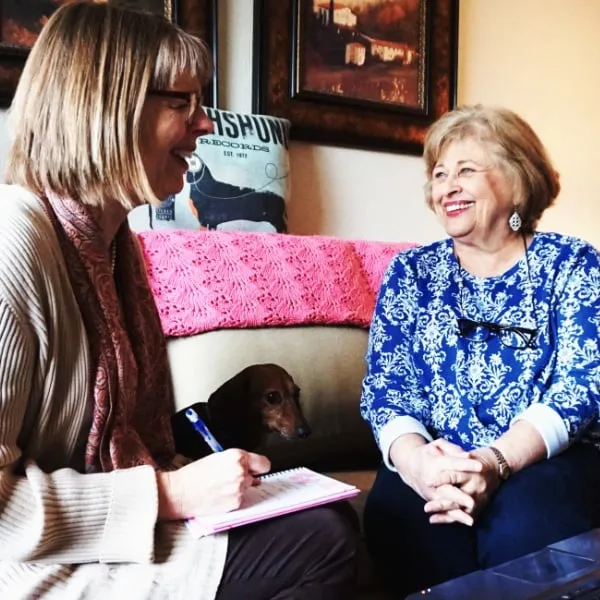
Lots of people make the mistake of choosing a well-written and established writer. But you wouldn't ask a tennis player to teach you how to swim. Ghostwriting a biography, memoir, or life story is a specialized skill. Ideally, you'll be choosing a ghostwriter who has ghostwritten before. If not, you need to make sure that they have some experience as an interviewer. You also need to make sure they can lay their ego at the door - this is your book, and it needs to be written the way you want it.
4. Not reading a relevant writing sample
Ask your writer for a relevant writing sample beforehand - something biographical or autobiographical. That way you can get a sense of his or her writing style when it comes to a project like your own.
5. No face-to-face interviews
Whether you’re talking to a company or an individual, you must make sure you have the option to be interviewed by your writer and in person. First - this makes a huge difference to the quality of the interview experience, which will ultimately shape the content of your book. Second - you want to be sure the person you’re talking to is actually the person who will write the book. Some companies use cheap labor to perform the interviews or to write up the text. You don’t want your life story to be outsourced! After all, how can someone write your story if they’ve never even met you?
Quick tip: If your writer can't find the time to meet you in person, how will they find the time to write your book? You should hire someone else.
6. No editor or editing process
You might think a good writer is all you need to write a book. Not so: all journalists and authors rely on editors to get their work into shape. Writers also rely on editorial staff to enforce deadlines and organize all aspects of production from design to printing. Unless you want to do all of that yourself, you need an editor.

7. Drafts: Failing to find out if, when, and how often you can request changes
It’s your story, so you should be able to request changes at specified points in the process. Some kind of redrafting is usually taken for granted - but you’ll want to find out when in the process you can request changes.
8. Not setting important deadlines upfront
Communication is key. Be clear about when you want your book to be finished from the beginning - and find out what will be required from you to stick to that schedule. If you need to give your input at a certain stage, make sure you put it in your diary so you don’t become the roadblock in the process! That way you can easily avoid taking longer than initially discussed.
9. Not knowing the full cost of producing your book
You may have received a quote for writing your book. But do you know the full cost of your project, including editing, proofreading, design, printing, and delivery? It’s tempting to just look at the fee your writer is proposing, and just ignore what you will then need to do to actually produce a book you’re proud of - don’t do it!
Hint: with Story Terrace, this is all included in the price!
10. False Promises: Don't believe you're going to get rich quick by publishing your book
If you want to share your story, that’s fantastic. But watch out for red flags: some writers or companies may try to show off by claiming they have ‘extensive contacts’ in big city publishing houses - or by showing amazing ‘case studies’ of previous customers who apparently have best sellers. The truth of the matter is that these contacts will not help write your book; and for most people, the fantasy of making a lot of money from their story is just that - a fantasy. If you’re serious about recording your experiences, your ghostwriter’s experience and qualifications are more important. Don’t get distracted!
If these sound like problems you're keen to avoid - just contact us: we will be able to recommend a ghostwriter you can trust.
Additionally, browse a selection of our 400 writers, here.
Now Is The Time To Share Your Story
StoryTerrace is your book production partner, including all ancillary activities from high-quality professional writing and editing to design, printing and publishing.


