
Discover The Stories StoryTerrace Help Share.
Explore inspiring stories, expert tips, and the latest trends in personal biography creation on our blog.
.png)
.png)
The Magic of Sharing Stories This Season
The most meaningful gifts don’t come wrapped; they come remembered.
.png)
Immigrant Experience-Based Bestseller: A Taiwanese Immigrant’s Journey to Kansas City by Benny “Goodman” Lee
We are proud to celebrate another StoryTerrace bestseller! From a childhood in Taiwan to a thriving life in the heart of America, Benny Lee’s story is a remarkable testament to resilience, entrepreneurship, and the power of giving back.
.jpg)
Inside the StoryTerrace Interviews
At StoryTerrace, every book begins with a conversation. Interviews are at the heart of what we do. To give you a peek behind the curtain, we sat down with Stefanie Fox, one of our Premium Writers. Stefanie shared her perspective on what makes an interview not just informative, but transformative.
%20(27).png)
Is This the Most Meaningful Gift of the Season?
As the holiday season approaches, the quest to find the perfect gift for loved ones without a wish list is just around the corner. But don't worry, we are here to lend a hand with some ideas that are meaningful, memorable, and delightfully unique!
%20(25).png)
StoryTerrace Spotlight: White Coat, Blue Gown by the late Dr. Barbara Tatham
We’re proud to feature White Coat, Blue Gown by the late Dr. Barbara Tatham, Family and Emergency Room Physician at London Health Centre, Toronto as our September Book of the Month.
Browse all articles

Get to Know Your Parents - Before They Were Your Parents!
Three great ways to capture your parents' life stories for future generations of your family
How much do you really know?
So many of your parents' stories took place before you were born, or were old enough to understand. Your parents know your whole history – but chances are you only know a fraction of theirs.
As our parents get older, these stories start to become more important to us. We want to preserve their memories – we don’t want them to be lost.
However you choose to record your parents’ life stories, the first step is to start talking. So today, we’re sharing four great ways to get the ball rolling.
1. Picture this…
A lot of our customers find old photo albums a great place to start. Take a day to bring out the old family albums with mum or dad. You'll find that it jogs the memory, brings up stories you never even knew about, and it’s also a fantastic way to begin assembling material for a memoir or biography.
It’s also an opportunity to digitize old pictures, which we strongly recommend. Nowadays, we are overwhelmed with photos. But older photos, from our parents’ childhood years, are often few and far between. It’s very likely you have no ‘back up’ of these pictures – old film and prints are liable to get damaged and lost forever! For this very reason, these older photos are infinitely more precious.
Luckily, with advances in technology, it has become easier to preserve old photos. Pictures can be scanned and stored safely online so that precious memories are not lost. As an added bonus, they are then easy to reproduce in a memoir or photo book. You can do it yourself by downloading an app, using a nearby print shop, or purchasing your own scanner.
2. Be your own family’s archaeologist
If you’re really serious (and brave), it’s time to have a look around the attic. Familiar with the film, Titanic? A search for a precious necklace, missing in the depths of the Atlantic Ocean led to the discovery of something priceless: the timeless love story of Jack and Rose. It’s not just Hollywood fiction – objects can really tell stories!
There’s a reason historians spend time digging up old Roman pots – it says a lot about how people lived their lives. Material culture can be just as important for you as your family’s historian. Your mom or dad’s memory won’t be infallible – mementos from the past can be important in bringing those truly old tales back to the present.
‘Why do you always wear that necklace, Mom?’ ‘Well, I was 13 and I was walking to school one day….’
By examining your parents’ old possessions, you won't just jog their memory, but make the story come alive for yourself, too!
3. Take note!
Now you’ve got your parents talking, you’ll want to keep a pen and paper handy. The stories your parents and grandparents share can be important insights into the past.
Stories dating to a time before you were born:
‘I had to be evacuated during WW2, I can still remember the sounds of the air raid sirens.’
Realities that seem so contrary from modern life:
‘I got my first job at 11 and have worked ever since.’
Make sure to jot down these little bits of information. And don’t forget to ask questions - use our memory prompts if you need some inspiration! It's through your curiosity that their life stories can truly take form.
4. Get professional help from Story Terrace!
We would all love to personally record our parents’ life stories. But it often isn’t that easy. It can be difficult to find the time to finish a project. It’s also hard to be an expert interviewer and writer on the first attempt. And then you'll still need to transform all of that work into a readable format you can share with your family – which involves editing the text, and designing and printing everything yourself.
Story Terrace is here to help you capture your parents’ lives in a book. Our professional ghostwriters have extensive experience interviewing our customers’ parents and structuring their memoirs and biographies. We have in-house editors who manage the process end-to-end, and we know how to beautifully present precious memories in a way that will last.
If you’d like to inquire about our services, feel free to contact us.

How StoryTerrace matches you with your perfect ghostwriter!
Our 4 steps to match you with the perfect ghostwriter for your story.
Capture the memories of your loved ones
That book then can be an amazing resource
Congratulations! You’ve decided to create your very own, beautifully bound StoryTerrace book. Our professional ghostwriters will help you to make your life story the best it can be.
The next step is to find your writer. With the largest pool of specialist ghostwriters in the world, part of what makes StoryTerrace unique is our ability to pair you with the perfect biographer for you.
As our Managing Editor, Alice Nightingale, says, “we pride ourselves on matching our clients with their ghostwriters carefully.” That means you can rest assured, knowing that you'll be working with a writer who can capture your story, find your voice, and make the process relaxed and enjoyable.
But how?
This happens through StoryTerrace’s tried and tested method of ghostwriter selection. So, how does it work? The infographic below explains the step-by-step process we use.
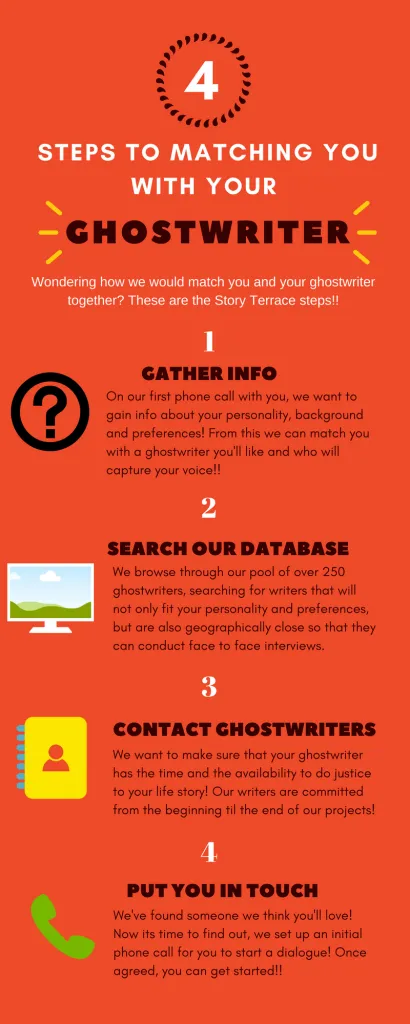
Step 1: Getting to know you
After you’ve decided to write your life story with StoryTerrace, you’ll have a brief consultation with your editor. We try to gather as much information as possible to ensure we find you the perfect fit.
“Everyone I spoke with at StoryTerrace was absolutely lovely and listened to all I had to say,” Isabella Matthews, StoryTerrace customer.
We want to know about your personality! For instance, matching you with someone who shares your sense of humour can help to build a rapport between you and your ghostwriter, making the writing process much more enjoyable.
At this stage, learning about your background is also extremely useful. It’s important that your writer understands you. When it comes to forging a mutual bond and finding your voice, a shared background or a common experience can make all the difference.
We also use this stage to ask about your preferences. We can accommodate most requests - whether it's something small - ‘I don’t want to work with someone that supports my rival football team’, or something more personal: ‘I would feel more comfortable sharing my experiences with someone of my own age’. Our goal is for customers and writers to feel comfortable, and create an atmosphere conducive to writing.
Step 2: Writer Search
StoryTerrace works with hundreds of professional journalists and authors - the largest pool of specialist ghostwriters in the world. That said - we know our writers like the back of our hands. Using the information from your consultation, your editor will propose ghostwriters who are a good fit for the project. Have a look at our writers’ profiles.
Additionally, we also consider your location. Interviews with your writer form the backbone of your story. We are almost always able to match customers with writers who are close enough to conduct the interviews in person, face-to-face. We think this makes the process more enjoyable, helping to develop a relationship between customer and ghostwriter, and making the end result more personal.


Step 3: Consult the ghostwriter
Next, we contact the top candidates for the job, and tell them about you and your project! It’s important for you to like your ghostwriter, and also for them to like you. If a mutual relationship flows, the final outcome becomes a labor of love.
It sounds obvious, but we also make sure that the writer is available for the duration of the project! You can read about the packages StoryTerrace offers here. For example, if you’ve purchased a Compact book package, your ghostwriter must be available for 3-4 hours of interviews and able to produce 5,500 words of your story. If you’ve paid for a Novella, the ghostwriter will carry out 8-10 hours of interviews and produce 20,000 words.
Whichever package you choose, the writer will be committed to the project from beginning to end, so we ensure you have the time together to tease out your life story!
“Sara really took the time to help me find the structure in the story of my life!” Teresa Samuels, StoryTerrace customer.
Step 4: Getting in contact
Hurrah, we’ve found your match! Now it’s time to put the two of you in contact.
You will have an initial phone call with your writer to make sure you’re happy with the match. This is an important opportunity to really discuss what you want the book to be about. Even at this stage, if you aren’t happy – you can choose a different writer. Writing your life story with StoryTerrace is, from beginning to end, a collaborative effort.
“Initially, we chatted on the phone and Lisa made it clear from the outset that if we didn’t ‘hit it off’ she would bow out gracefully and I could choose another writer”. David Taylor, StoryTerrace customer
So there it is, the secret to finding your perfect ghostwriter! If you’re ready to get started, contact us to begin your StoryTerrace experience today!

How to Collect and Record Memories
Some fun and creative ways to start preserving your memories for future generations and family
Turning the meaningless into the meaningful
Create an amazing resource full of memories
We record memories and keep mementos, often without realizing, on a daily basis. We know the stories behind the photos and trinkets we keep, but to a stranger, our collection is meaningless.
For example, you may pick up a photo of yourself with friends, sitting around a table. You look fondly at the picture, chuckling, remembering all the events that occurred that night. But, let’s say your great-granddaughter picks up this same photo 40 years from now. What would she see?
Now imagine this same photo, but with the caption: ‘The gang, aged 25, the night Dan proposed to Jen’. Not only will your great-granddaughter laugh at what you’re all wearing, she now has context behind the image. Having a simple record of who people are and your relationship to them can turn something meaningless into something meaningful for those around you.
Collecting Memories
So what exactly should you be collecting? Well, we’ve comprised a list of useful items that will trigger your memories when recounting your stories.
Photographs and Films
Photographs and films are probably the most obvious visual cues for recalling memories. A photograph directly shows what someone or something looked like. However, this doesn't mean the picture alone conveys the whole story, or how you experienced it.
Especially in this day and age, images can be construed to convey a certain message. Therefore, relying on photographs alone to remember people and events might not be completely reliable.
Rachel LaCour Niesen, a keen photograph preservationist, gives us an insight into why she is so passionate about photography, as well as ideas on how to display photographs:
"There’s magic in holding printed photos in your hands, in passing them around the table. That's because analog photos trigger powerful emotional responses. Most families have hundreds of analog photos in their homes. These photos hold valuable family memories; they are passports to a place called memory. We must make an effort to rescue them from deterioration and loss. When analog photos are in danger, family history is also in danger.
“Indeed, photographs are a living, breathing archive. They are meant to be displayed and shared. Whether they're displayed in frames, in an old-school slideshow, or in albums, I hope all families recognize the value of their personal photographic histories. Can you imagine never having the magical experience of discovering a box of family photos? It’s like finding buried treasure! I would love to guarantee that experiences like that aren’t lost in the future.”
For more ideas and advice on how to preserve old photographs visit Rachel’s site: SaveFamilyPhotos.com
Diaries and Letters
Diaries and letters serve as powerfully written cues for recalling memories. Letters can reveal a great many things, from sharing big news to revealing secret love affairs. Meanwhile, diaries are a personal way of recording your thoughts and feelings whilst they're still fresh, as it is often harder to remember details in hindsight.
In an interview conducted by the National Diary Archives, specialist diary collector, Sally Macnamara, gives us an insight into why this became her passion:
“The most important thing I would say is that real life is so much more exciting and rewarding to read about than any story anyone could make up. And that no matter who you are, every life, every true story, has fascinating aspects to it, and that we all have a story to tell. So many people think they have nothing to share, nothing to teach, nothing that’s worthwhile in their life, but that is so untrue.”
For more inspiration on collecting diaries and to follow some truly amazing diary stories visit Sally’s Diaries.
Newspaper Clippings
Saving newspaper and magazine clippings of significant stories is another great way to preserve memories. Many of us rely on cues to jog our memories. Therefore, keeping a record of important news stories is a great way to remind us what we were doing at the time of the event or at the point of reading the story.
Additionally, keep meaningful magazine clippings and display them in a frame or in a book. Preserving clippings in this way can also be a great way of presenting an album of events that occurred throughout your life, quickly and with little effort.
Mementos
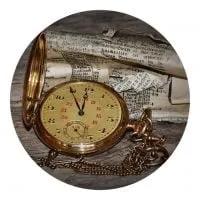
The beauty of collecting mementos is that every collection, and every item in that collection, is unique. Keeping a box of objects you’ve collected over the years serves as a treasure trove for your grandchildren. You'll probably feel nostalgic, too.
The objects do not need to be valuable or even attractive. It’s all about keeping items that will remind you of a special time. Keeping a ticket stub may be all you need to remember one of the best weekends of your life.
The box itself could also be something significant. Just as all the objects inside are specific and special to you, so the container could be too. Some people may keep their trinkets in their favorite cookie box. Others may appropriate an old shoe box and collage it with stamps they’ve collected.
So, what are you waiting for?
There is no specific time to start recording your memories. However, the sooner you start, the more memories you'll preserve and the more you'll have to share with future generations. It’ll also make the process of writing your own life story or having a ghostwriter to do the writing for you much simpler when you come to it.

Memories: the Importance of Sharing Them
Why it's so important that we share our memories with our families and loved ones!
Memories are the adhesive that fastens pictures to the walls of the rooms of our past. Over time the tenacity of the glue may start to wear, the frames may tilt and you see the images from a different angle; or they might drop off the wall completely.
Memory is the lens through which we gaze into the future. Our past experiences, emotions, observations; our sense of identity ultimately shapes our future thoughts and actions. And they are constructed through the tinted viewfinder of our mental memoirs.
“Life can only be understood backwards, but it must be lived forwards.” - Søren Kierkegaard
Documenting Change
Have you ever come across an old storage box and spent hours going through your old possessions; letters, birthday cards, photographs? Reminiscing can be one of life's true, unpredictable, and thrilling delights. With it can come realization of how far you have come, how much you have changed; or haven’t. The overwhelming oneness of you and your past, the present, and your hopes for the future.
In his play The Cocktail Party, T.S. Eliot writes:
"We die to each other daily. What we know of other people is only our memory of the moments during which we knew them. And they have changed since then."
Our memories of other people are based on the brief encounters we have with them. Every time we see them they are reborn, and every time we leave them, they, in effect, cease to exist.
We change every day, which is why it’s even more important that we make an effort to document ourselves. Keeping memories preserved for our family, our children, our grandchildren and, in times when the glue starts to deteriorate, for ourselves.
A Transient Present
When my grandmother died I found out more about her during the few hours at her funeral than during the rest of my life. To me, that felt profoundly sad. The Vicar, a stranger to me (and my grandmother), for those minutes, knew more about my grandmother than I did. He read notes from a piece of paper, brief memories collated by my mother and her siblings. For various reasons, I hadn’t seen her for 15 years. My strongest memory of her is the memory of her funeral. That’s not how anyone wants to be remembered or to have to remember others.
We must live in the present, they say. The present is fleeting, temporary, and brief. Living in the present can be fun, cleansing, and liberating, but ultimately ephemeral. If we don’t spend time reminiscing and recording it, then we risk leaving a traceless presence. We risk our grandchildren never really knowing who we were or what we stood for. Memories need to be shared; reminiscing and reflection force us to exist outside and beyond the present.
We think we will always be able to remember; and then comes an unsettling time when we realize this is not the case, as we struggle to recall details or dates, faces or feelings.

Memory Spam
Rather than relying on our brains, we rely on email search tools for past conversations, Google for old recipes and remedies, and Facebook for people we used to know and events we went to. Our memory is becoming second-rate, equivocal, and time-consuming compared to what computers can tell us clinically and accurately in seconds.
Are we clogging our minds unnecessarily with adverts? Are we paying too much attention to other peoples’ lives? Or are our brains and cognitive memories working hard and adapting by having to interpret and prioritize many things at once?
It’s true that younger generations seem to be very comfortable on their smartphones, laptops, iPads, and watching TV all at once, but how much of it do they actually take in and remember? Is it the sign of a highly trained multi-tasking brain, or is very little actually sticking around for the long term?
Memory span is becoming memory spam. We need to be careful that the pages of our memory diaries are not all blank, but that while certain pages may get scribbled on, ripped out or read aloud at social gatherings over and over again, they are still looked at and reflected upon every once in a while. Long-term memory lays at ease with long-form writing; a novel of your life allows room to tell the stories of your life in detail while also reflecting, yourself, on why and how they shape who you are today.
Reflection
German philosopher, Arthur Schopenhauer, believes that ‘just as one spoils the stomach by overfeeding and thereby impairs the whole body, so can one overload and choke the mind by giving it too much nourishment.’
Thus it can be impossible to reflect, and, he believes, it ‘is only by reflection that one can assimilate what one has read’. Hence it is only by reflection that we can appreciate our past and our achievements, in a world where so much is happening all at once. He concludes that ‘if one reads straight ahead without pondering over it later what has been read does not take root, but is for the most part lost.’
It is this loss that one might reasonably fear most. We can take our memory for granted, yet without it, the present would be a self-destructive, transitory, and effectively pointless and repetitive loss. We would live purely on instinct and be denied the benefit of experience. As children’s author Lois Lowry puts it (and I think this is fitting, since our childhood memories are the ones we often remember most fondly):
‘The worst part of holding memories is not the pain. It’s the loneliness of it. Memories need to be shared.’
So you want to start making a record of your memories? Read How To Collect and Record Memories to find out how!

How To Write Your Life Story
Find the time to put your life story into motion with our tips on getting started!
Capture your memories for your loved ones
I once came across a quote by the author Kate Rockland, which read: “Relationships consist of telling your same life stories to different people until someone finally appreciates them.” Although a little on the soppy side, this idea about the power of the life story and the realization that our stories literally make us did really hit home.
<!--more-->
Now, most people wouldn’t consider themselves storytellers and definitely wouldn’t consider themselves authors. But really, that is exactly what we are; storytellers. By going about our day-to-day lives, we are unwittingly writing our own stories. By telling our spouses about our days, we are telling stories. We create and develop plot lines, settings, and characters, which together make up the stories of our lives.
So why is recording our stories such a daunting task? It is often down to a lack of time and the fear of not knowing how or where to begin.
“Relationships consist of telling your same life stories to different people until someone finally appreciates them.”
With regard to the time issue, or rather, the mindset issue – it is notable that one of the most common excuses for not doing things is because we don’t have the time. Why not start by substituting one hour of television per week with writing instead?
Writing doesn’t have to be a chore, it doesn't necessarily even need to be a conscious effort. Writing anything, even on the most basic level, can serve as a record of our life stories.
In this age of selfies and hashtags, we are constantly telling millions of people our stories, every day. Social media has advanced the ways and means to tell stories. Sharing a selfie, wearing smart clothes with a cheesy grin on your face, accompanied by the caption: ‘So #excited for the #firstday of my new job!' tells a story. But how exactly do we go about converting all these snippets of our lives into a life story?
How do I get started?
Most stories have a relatively clear beginning, middle, and end, separated into chapters, with characters and settings. When you begin to break things down to the most basic level, your stories start to make a little more sense. Consequently, writing your life story becomes a slightly less daunting task.
Beginning: this could be your family before you, your birth, your early childhood memories.
Middle: the significant events that have made up the bulk of your life.
End: this can be where you are now, your current relationships, and your plans for the future.
We've put together a super-handy list of questions to recall some of those forgotten memories, as well as a free downloadable timeline to get you started on your life story. You can find these here:
Okay, I've done that. What now?
Execution is often the most difficult and daunting part as ‘blank page syndrome’ tends to affect us all. As a result, we procrastinate. Luckily for us, however, professional biographer, Andrew Crofts, has provided some insight into how best to approach making sense of our memories:
“The best thing is to write from memory first because then the most interesting and important events and characters will rise to the surface. Then go through all the source material like diaries to check that you have got the facts right and that you haven't forgotten anything vital.
“If you find the idea of writing a book daunting, start out by imagining you are writing a letter to a long-lost friend, telling them everything that has happened since you last saw them. That way your natural voice will come through.
“Getting the first block of material down is always the hardest part. Editing, tweaking, and expanding are the fun bits once the bulk of the project has been done.”
Remember, writing your life story is not the same as writing a memoir. If this is news to you, check out our Memoir vs Autobiography: What's the Difference? article.
Overall, it is important to maintain a balanced structure throughout your ‘life story’, so it feels like just that; a ‘life story’ and not just one of 'life’s many stories’.

10 Mistakes to Avoid when Choosing a Ghostwriter
Ten tips and tricks to avoid choosing the wrong ghostwriter for your biography, life story or memoir.
<p style="margin-bottom: 0;"><em style="font-size: 20px; background-color: transparent;"><strong>In the age of the internet, </strong>it can seem easier than ever to find people to help with… almost anything! From laundry, to taxis, and even <strong>writing your life story, memoir or autobiography.</strong> Unfortunately, when it comes to choosing a ghostwriter for your book, it’s all too easy to make a costly mistake - especially if you are relatively new to the scene.</em></p>
<p>When you’re investing in something as important as your own story, you want to get it right. <strong>You don’t want to choose the wrong person:</strong> you could find you have to abandon the project halfway through and start again; or worse, that the finished product bears no resemblance to what you were hoping for.</p>
<!--more-->
<p>Story Terrace removes this worry by carefully vetting our pool of talented, professional ghostwriters. We screen applications from writers every day - which means we’ve seen it all! Take it from us, we know what we're talking about - these are <strong>10 mistakes you should NEVER make when choosing a ghostwriter:</strong></p>
<h2>1. Not checking their published work</h2>
<p>Is your writer published? Who by? A professional writer worth their salt should have some published work. If an editor won’t take a chance on them, why should you? The one exception may be a recent graduate from a prestigious literature, journalism or creative writing course - these writers may be highly talented despite a relative lack of published material.</p>
<h2>2. Not requesting a reference or trusted recommendation, and not reading reviews!</h2>
<p>So you’ve found a ‘writer’ online. But they could be anyone! You need to do your research or rely on a recommendation you can trust. Can they provide a reference from a previous client or employer? Have they been reviewed anywhere on the internet? Best of all - have they been recommended by an expert company (like Story Terrace!) that has worked with them in the past?</p>
<span class="square-image"><img src="https://cdn2.hubspot.net/hubfs/3921157/Blog/interview.jpg" alt="interview.jpg" title="interview.jpg" width="600" caption="false" data-constrained="true" style="width: 600px;"></span> <span class="square-image"><img src="https://cdn2.hubspot.net/hubfs/3921157/Blog/article 4.jpeg" alt="article 4.jpeg" title="article 4.jpeg" width="1349" caption="false" data-constrained="true" style="width: 1349px;"></span>
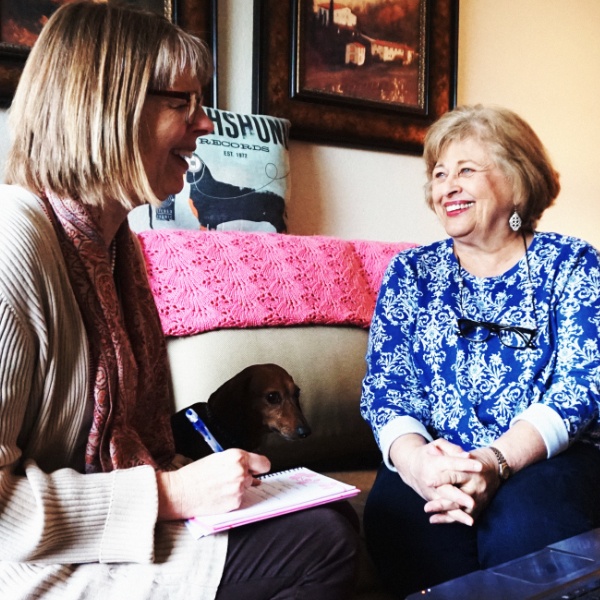

<h2>3. Choosing a writer - not a <em>ghost</em>writer</h2>
<p>Lots of people make the mistake of choosing a well-written and established writer. But you wouldn't ask a tennis player to teach you how to swim. Ghostwriting a biography, memoir or life story is a specialised skill. Ideally, you'll be choosing a ghostwriter who has ghostwritten before. If not, you need to make sure that they have some experience as an interviewer. You also need to make sure they can lay their ego at the door - this is your book, and it needs to be written the way you want it.</p>
<h2>4. Not reading a relevant writing sample</h2>
<p>Ask your writer for a relevant writing sample beforehand - something biographical or autobiographical. That way you can get a sense of his or her writing style when it comes to a project like your own. </p>
<h2>5. No face to face interviews</h2>
<p>Whether you’re talking to a company or an individual, you must make sure you have the option to be interviewed <strong>by your writer</strong> and <strong>in person</strong>. First - this makes a huge difference to the quality of the interview experience, which will ultimately shape the content of your book. Second - you want to be sure the person you’re talking to is actually the person who will write the book. Some companies use cheap labour to perform the interviews or to write up the text. You don’t want your life story to be outsourced! After all, how can someone write your story if they’ve never even met you?</p>
<p>Quick tip: If your writer can't find the time to meet you in person, how will they find the time to write your book? You should hire someone else.</p>
<h2>6. No editor or editing process</h2>
<p>You might think a good writer is all you need to write a book. Not so: all journalists and authors rely on editors to get their work into shape. Writers also rely on editorial staff to enforce deadlines and organise all aspects of production from design to printing. Unless you want to do all of that yourself, you need an editor.</p>
<p><img src="https://cdn2.hubspot.net/hubfs/3921157/_DSC3515-1.jpg" alt="_DSC3515-1.jpg" width="765" style="margin: 0px 10px 10px 0px; float: left; width: 765px; height: 222px;" title="_DSC3515-1.jpg" caption="false" data-constrained="false"></p>

<p> </p>
<div>
<h2>7. Drafts: Failing to find out if, when, and how often you can request changes</h2>
<p>It’s your story, so you should be able to request changes at specified points in the process. Some kind of redrafting is usually taken for granted - but you’ll want to find out when in the process you can request changes.</p>
<h2>8. Not setting important deadlines up front</h2>
<p>Communication is key. Be clear about when you want your book to be finished from the beginning - and find out what will be required from you to stick to that schedule. If you need to give your input at a certain stage, make sure you put it in your diary so you don’t become the roadblock in the process! That way you can easily avoid taking longer than initially discussed.</p>
<h2>9. Not knowing the full cost of producing your book</h2>
<p>You may have received a quote for writing your book. But do you know the full cost of your project, including editing, proofreading, design, printing, and delivery? It’s tempting to just look at the fee your writer is proposing, and just ignore what you will then need to do to actually produce a book you’re proud of - don’t do it!</p>
<p>Hint: with Story Terrace, this is all included in the price!</p>
<h2>10. False Promises: Don't believe you're going to get rich quick by publishing your book</h2>
<p>If you want to share your story, that’s fantastic. But watch out for red flags: some writers or companies may try to show off by claiming they have ‘extensive contacts’ in big city publishing houses - or by showing amazing ‘case studies’ of previous customers who apparently have best sellers. The truth of the matter is that these contacts will not help writing your book; and for most people, the fantasy of making a lot of money from their story is just that - a fantasy. If you’re serious about recording your experiences, your ghostwriter’s experience and qualifications are more important. Don’t get distracted!</p>
<p><strong>If these sound like problems you're keen to avoid - just <span style="text-decoration: underline;"><a href="https://storyterrace.com/en-GB/contact/">contact us</a></span>: we will be able to recommend a ghostwriter you can trust.</strong></p>
<p><strong>Additionally, browse a selection of our 400 writers, <a href="https://storyterrace.com/en-GB/ourwriters/" target="_blank"><span style="text-decoration: underline;"></span><span style="text-decoration: underline;">here</span></a>.</strong></p>
<div class="separator"> </div>
</div>

Why I Started a Company to Record Family Stories
We've identified the top three reasons to start writing your parents' life story, now. Plus: A free download to get started on your story.
Plus: An easy first step to get started (free download)
I loved my grandfather’s stories. The room filled with cigar smoke, I would listen to tale after tale as we played backgammon together. I loved to hear about his adventures with his football team or the time he met my grandmother.
This is the kind of history we feel most connected to - that of our own families. Their experiences. Their emotions. Their eyewitness accounts of the moments that shaped their lives.
Sadly, when my Grandfather passed away, I realized that the details of those old stories had faded. I had missed the chance to make a record of my grandfather’s life.
"I can still recall some of their experiences. But will I be able to do them justice when I tell snippets of them to my children and grandchildren one day?"
Today, this is a common problem. We have Facebook pages, old home movies, and photo albums. But these are often left scattered in boxes, on old computers, and discarded and broken phones - and they often don’t tell the important stories.
This is why, two years ago, I set up my company, Story Terrace. We help people to capture their Mom or Dad’s life story in a beautiful hardbound book by matching them with a professional writer.
People like Peter, for instance, who started a new life in the West as a dishwasher after the Russians invaded his hometown of Prague in Czechoslovakia. Or Sue, who gave up her job as a nurse to take care of her three children.
Sue, Peter, and hundreds of others have come to us at Story Terrace for help with writing their autobiographies – to tell their stories for generations to come. Not as some kind of vanity exercise, but to give their families a profound sense of where they come from. To show that every life has its ups and downs, its triumphs, and struggles.
I wish my grandparents had done the same as Peter and Sue. Their stories have faded faster than I could ever have imagined. I can still recall some of their experiences – experiences that have, after all, shaped my values and interests. But will I be able to do them justice when I tell snippets of them to my children and grandchildren one day?
So if you love your parents’ stories - if you want your children to remember their grandparents - then however you do it, capture them while you still can.
I am Rutger Bruining, Founder and CEO of Story Terrace, and I hope that together we can change the way that history is written.
Next steps: Two ways you can start capturing your parents' stories today
i) Download Our Free Guide
Subscribe and we'll send you our free guide, starting with 65 Memory Prompts you can ask your parents to get started.
ii) Work with a Story Terrace Writer
Story Terrace offers a complete service for capturing your parents' life story in a book, with packages starting from £1350.

Top 5 heartfelt gifts celebrities have given their parents
We've found the most meaningful gifts celebrities have given their parents. Plus: A free download to get started on their favourite gift yet.
Plus: the most meaningful gift you can give your loved ones (free download)
These celebrities know that they wouldn’t be where they are today without constant love, sacrifice, and support from their parents. They want to show their appreciation for their parents, just like the rest of us.
In a world dominated by superficial wealth, these famous faces honored their parents with meaningful gifts that demonstrate just how thankful they are.
And what makes these gifts even more appealing? You can give them, too.
"I know about being loving and caring, and sacrificing and showing up and being present in my children’s lives - I learned all of that from [my mother's] example.”
1. Leonardo DiCaprio's bountiful bouquet
If your Mom or Dad has a particularly green thumb, this might be an ideal gift. Oscar Winner Leonardo DiCaprio passed up the boring bouquet of flowers his mother might have expected to receive on a special occasion. Instead, Leo dedicated an entire grove of trees in southern California to his mother and grandmother.
For a more economically viable ‘thank you’ than an entire grove - you could plant a tree or sponsor an acre of rainforest to preserve in their honor.
2. Ryan Reynolds' unconventional calendar
Every year, the famous actor gets behind the lens - where he stages an entire photo album for his parents, recreating the main events of the year. Reynolds’ admits to USA Today that “it’s those personal gifts that really set my parents on fire.” Even for the rich and famous, ‘customized and thoughtful’ triumphs over ‘expensive and extravagant’, every time.
All you need is a camera to create this thoughtful gift. Or, why not try recreating old family photos from your childhood?
3. LeBron James' touching tribute
NBA champion LeBron James melted mothers' hearts the world over, by publishing a moving essay in his Mom’s honor. LeBron writes that “everything I’ve learned about being a parent to my boys ... everything I know about being loving and caring...I learned all of that from her example.”
A written tribute is a fantastic way to show your appreciation to your loved ones. Whether you publish your words like LeBron or keep them private, they will touch your parents in a way money can’t buy.
4. Justin Bieber’s empowering homage
Multi-platinum artist Justin Bieber released a song on Mother’s Day called “Turn to You”. The song was dedicated to his mother, with an empowering message about her struggles and bravery as a young parent. If this moving tribute wasn’t enough, all of the proceeds made from the track were dedicated to the Bethesda Centre that helped Bieber’s mother when she was pregnant with Justin.
If you aren’t quite as confident as Bieber, why not have your children perform a song - or write your parents a poem?
5. Britney Spears’ book of love (Our Pick!)
Pop sensation and mother of two, Britney Spears, paid the ultimate tribute to her mother by writing a biography about her - called ‘Heart-to-Heart’. The honest book captures her mother’s story as well as their unique mother-daughter bond.
Britney and her mother were able to better understand each other and their decisions, reflecting on life and bringing them closer as well as sharing new, untold stories. If like Britney, you want to show your appreciation for everything your parents have accomplished, why not honor them with a book about their lives?
Writing your Mum or Dad's life story is the ultimate gift. Here are two ways to do it:
i) Download Our Free Guide
Subscribe and we'll send you our free guide, starting with 65 Memory Prompts you can ask your parents to get started.
ii) Work with a Story Terrace Writer
Story Terrace offers a complete service for capturing your parents' life story in a book, with packages starting from £1350.
3 Powerful Reasons to Write Down Your Life Story in 2018
We've identified the top three reasons to start writing your life story, right now. Plus: A free download that's an easy first step to get started on your story
Plus: An easy first step to get started (free download)
Have you ever thought about writing down your life story? Perhaps you've started a journal or even thought about writing a memoir...
Today, more and more people are recording their memories. In fact, it’s become so popular, you can even hire a writer online to do the hard work for you.
So what's behind the trend? We spoke to dozens of amateur autobiographers - and we've identified the top three reasons to start writing your story, right now.
Plus - we have an easy first step to get started, including a free downloadable guide!
“I wanted to give my children and their families a greater understanding of the family that they came from”
1. There's no greater gift for your family
Barbara decided to record her life story after her mom died. She realized how little she knew about her own parents and grandparents. She told us, “I wanted to give my children and their families a greater understanding of the family that they came from.”
Family history is so much more than a family tree. When you write about your life, you can go beyond the names and dates. Your children and grandchildren can discover what life was like where you grew up and learn precious details about their extended family that may otherwise be lost.
The book can become an heirloom, full of beautiful anecdotes, which your family adds to down the generations. Dominic received the true story of his grandparents' love affair, immortalized in a book for his 40th birthday. He told us it was "the best gift I've ever received".
2. Find the meaning in your life story (so far!)
For Teresa, 71, “making this book has given me the time to reflect on what I chose to do with my life and the people who have helped me along the way.”
Documenting your life is a great way to appreciate the impact you’ve had in the world, reflect on your decisions, relationships, and accomplishments. Take stock of how far you have come, with a personal record of your life’s achievements in your own words.
Susan told us: “Writing my own book was a first-time experience. I am so proud of the book and the story! I have found structure to my life. Looking back has filled me with excitement for what’s still unwritten.”
3. Rediscover and reconnect
Reflecting on your life can bring back long-neglected memories and relationships. Janet, 70, said that writing her book “brought out all sorts of things that I had completely forgotten about.”
Revisiting your past may be the opportunity you need to rekindle childhood friendships and strengthen family bonds.
Two Ways to Start Your Story Today
i) Download Our Free Guide
Subscribe and we'll send you our free guide, starting with 65 Memory Prompts designed to jumpstart your life story.
ii) Work with a Story Terrace Writer
Story Terrace offers a complete service for capturing your life story in a book, with packages starting from £1350.


